Would you have a problem if I coloured this bit green? Yeah, that’s what I’ll do, this bit green and the other part yellow.”
She enjoys colouring as it occupies and relaxes her, along with wordsearch books (though sometimes she comes up with solutions different to those the setters had in mind). ‘She’ is my mother, Gretta Hurley, she is 61 since February and she has frontotemporal dementia (FTD).
Initially, it seemed like lethargy, apathy or depression. That led to frustration on the part of us, her family, but there is at least some consolation in the fact that nothing extra could have been done, even if it had been diagnosed earlier. In simple terms, the frontal lobes, which moderate behaviour and judgement, begin to shrink and, in technical terms, that leads to things going a bit haywire.
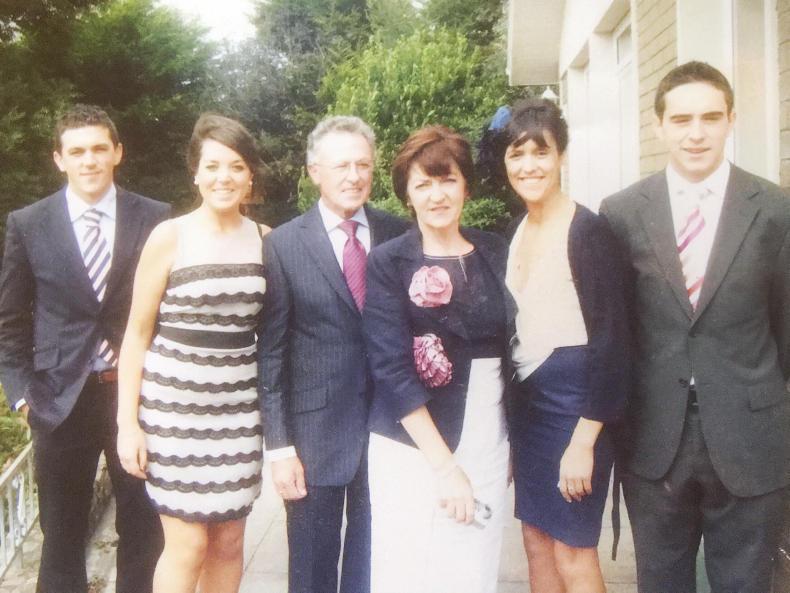
The Hurley family pictured in happier times in 2011, from left to right: Denis, Lorna, Jim, Gretta, Susan and James.
My mother is no longer the loving, hardworking presence she was and the empathy which was such a virtue has been stripped from her. She has not been able to be as involved in the planning of my two sisters’ weddings, to assist my younger brother into adulthood, to be the excellent grandmother she would have been or to enjoy her golden years with my father. And yet, she still remembers the address she stayed at in Sacramento when visiting her aunt, a nun, there four decades ago, or sings along to classic songs when they’re played (she won’t sing when asked, though).
She is still there but she’s not there. She’s Schrödinger’s Mother.
The colouring books are a nice parallel to illustrate her thoughtfulness. I can recall spending a day at a neighbour’s house and unearthing a colouring book that depicted images of football games. Not the most sociable at the time, it was an ideal way for me to while away the afternoon in solitude. I mentioned it in passing to my mother and a couple of days later I came home to find a set of three football colouring books, in sizes A4, A5 and A6.
That was just one of a million selfless acts. After I returned home from a pilgrimage to Lough Derg in 2007, I had to remain fasting for the rest of the day. My mother had visited St Patrick’s Purgatory on more than one occasion and knew how to make the rules work to her advantage. As she went to bed that night at about half past 11, she told me that there was a dinner left for me and that I could put it in the microwave after midnight, simultaneously satisfying my hunger and keeping up my end of the bargain with God and St Patrick.
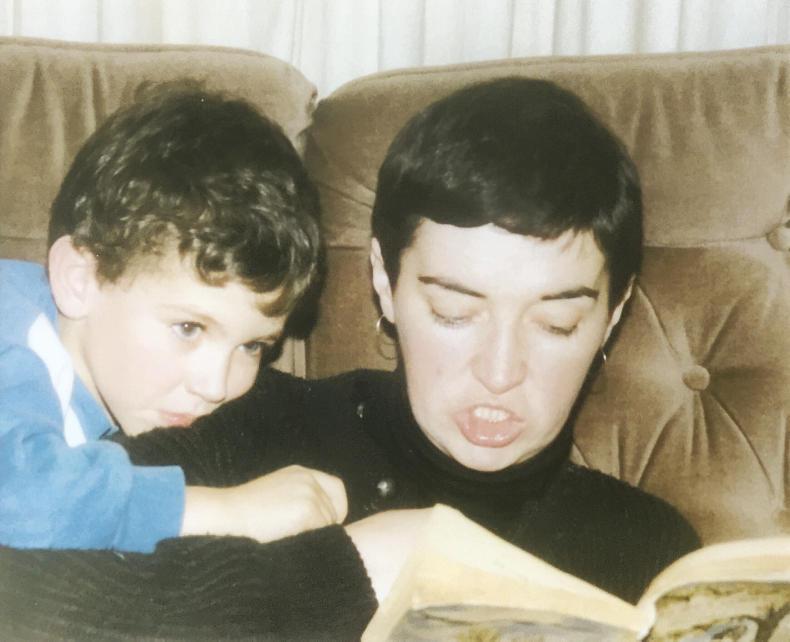
Denis Hurley pictured with his mother Gretta as a child.
It was she who always thought I’d end up writing, even when I reckoned I’d become an accountant. And, a few years later, when I expressed out loud the thought that binoculars would help me in my role as a sports journalist, she got a pair for my next birthday. It’s important to stress that this wasn’t favouritism towards me – she was that generous with everybody.
One by-product of FTD is that the sufferers become more straight-talking. Utterances that might otherwise be considered a biting sense of humour are commonplace. When my aunt, a nurse in a care home, mentioned that a certain woman had been a client there before she died, my mother’s retort was: “They all come into ye to die, how many more are ye going to knock off?” And while we may never know just why my mother considers a certain racing driver to be “a sickening eejit”, as my father says, it doesn’t mean she’s wrong.
It’s that sense of perspective that makes it somewhat easier to live with the current situation, if not to accept it
I wonder if there were any things that she would like to have done, but her life has been a positive one. She has enjoyed a great marriage with my father and raised four children to live the right way. Her consideration for others always shone through – when we would complain of our lot, we were gently but firmly reminded that so many other children would love to be in the position we found ourselves in.
It’s that sense of perspective that makes it somewhat easier to live with the current situation, if not to accept it. It makes me sad for those who have FTD and who are not as lucky – isolated, perhaps, as a result of perceived rudeness or laziness brought about by the condition, and left confused by this desertion.
My mother is happy – she literally does not have a care in the world. In the three years since her diagnosis, it has been a slow and gentle decline and it is currently a manageable situation. People say that it must be tough, but the human condition is to adapt to new normalities quite quickly. She’s still at a manageable stage and goes along with things, such as finishing up her job, without questioning them. I’ve told my mother more lies in the past three years than in the previous 31, but it’s often the easier course of action. There will almost certainly be difficult days and hard decisions ahead, but the situation is a reactive one and you take it as it comes.
My mother has a loving family around her and an army of friends and relations. They have all benefited from her kindness, compassion and companionship over the years and are more than happy to help.
It’s all worth it for a smile or a laugh from her. For us, her family, it’s something of a role-reversal to be waiting on her, but it’s easy for us to repay all she has done.
Read more
Preserving memories with a memory room
Understanding dementia
Would you have a problem if I coloured this bit green? Yeah, that’s what I’ll do, this bit green and the other part yellow.”
She enjoys colouring as it occupies and relaxes her, along with wordsearch books (though sometimes she comes up with solutions different to those the setters had in mind). ‘She’ is my mother, Gretta Hurley, she is 61 since February and she has frontotemporal dementia (FTD).
Initially, it seemed like lethargy, apathy or depression. That led to frustration on the part of us, her family, but there is at least some consolation in the fact that nothing extra could have been done, even if it had been diagnosed earlier. In simple terms, the frontal lobes, which moderate behaviour and judgement, begin to shrink and, in technical terms, that leads to things going a bit haywire.
The Hurley family pictured in happier times in 2011, from left to right: Denis, Lorna, Jim, Gretta, Susan and James.
My mother is no longer the loving, hardworking presence she was and the empathy which was such a virtue has been stripped from her. She has not been able to be as involved in the planning of my two sisters’ weddings, to assist my younger brother into adulthood, to be the excellent grandmother she would have been or to enjoy her golden years with my father. And yet, she still remembers the address she stayed at in Sacramento when visiting her aunt, a nun, there four decades ago, or sings along to classic songs when they’re played (she won’t sing when asked, though).
She is still there but she’s not there. She’s Schrödinger’s Mother.
The colouring books are a nice parallel to illustrate her thoughtfulness. I can recall spending a day at a neighbour’s house and unearthing a colouring book that depicted images of football games. Not the most sociable at the time, it was an ideal way for me to while away the afternoon in solitude. I mentioned it in passing to my mother and a couple of days later I came home to find a set of three football colouring books, in sizes A4, A5 and A6.
That was just one of a million selfless acts. After I returned home from a pilgrimage to Lough Derg in 2007, I had to remain fasting for the rest of the day. My mother had visited St Patrick’s Purgatory on more than one occasion and knew how to make the rules work to her advantage. As she went to bed that night at about half past 11, she told me that there was a dinner left for me and that I could put it in the microwave after midnight, simultaneously satisfying my hunger and keeping up my end of the bargain with God and St Patrick.
Denis Hurley pictured with his mother Gretta as a child.
It was she who always thought I’d end up writing, even when I reckoned I’d become an accountant. And, a few years later, when I expressed out loud the thought that binoculars would help me in my role as a sports journalist, she got a pair for my next birthday. It’s important to stress that this wasn’t favouritism towards me – she was that generous with everybody.
One by-product of FTD is that the sufferers become more straight-talking. Utterances that might otherwise be considered a biting sense of humour are commonplace. When my aunt, a nurse in a care home, mentioned that a certain woman had been a client there before she died, my mother’s retort was: “They all come into ye to die, how many more are ye going to knock off?” And while we may never know just why my mother considers a certain racing driver to be “a sickening eejit”, as my father says, it doesn’t mean she’s wrong.
It’s that sense of perspective that makes it somewhat easier to live with the current situation, if not to accept it
I wonder if there were any things that she would like to have done, but her life has been a positive one. She has enjoyed a great marriage with my father and raised four children to live the right way. Her consideration for others always shone through – when we would complain of our lot, we were gently but firmly reminded that so many other children would love to be in the position we found ourselves in.
It’s that sense of perspective that makes it somewhat easier to live with the current situation, if not to accept it. It makes me sad for those who have FTD and who are not as lucky – isolated, perhaps, as a result of perceived rudeness or laziness brought about by the condition, and left confused by this desertion.
My mother is happy – she literally does not have a care in the world. In the three years since her diagnosis, it has been a slow and gentle decline and it is currently a manageable situation. People say that it must be tough, but the human condition is to adapt to new normalities quite quickly. She’s still at a manageable stage and goes along with things, such as finishing up her job, without questioning them. I’ve told my mother more lies in the past three years than in the previous 31, but it’s often the easier course of action. There will almost certainly be difficult days and hard decisions ahead, but the situation is a reactive one and you take it as it comes.
My mother has a loving family around her and an army of friends and relations. They have all benefited from her kindness, compassion and companionship over the years and are more than happy to help.
It’s all worth it for a smile or a laugh from her. For us, her family, it’s something of a role-reversal to be waiting on her, but it’s easy for us to repay all she has done.
Read more
Preserving memories with a memory room
Understanding dementia







SHARING OPTIONS